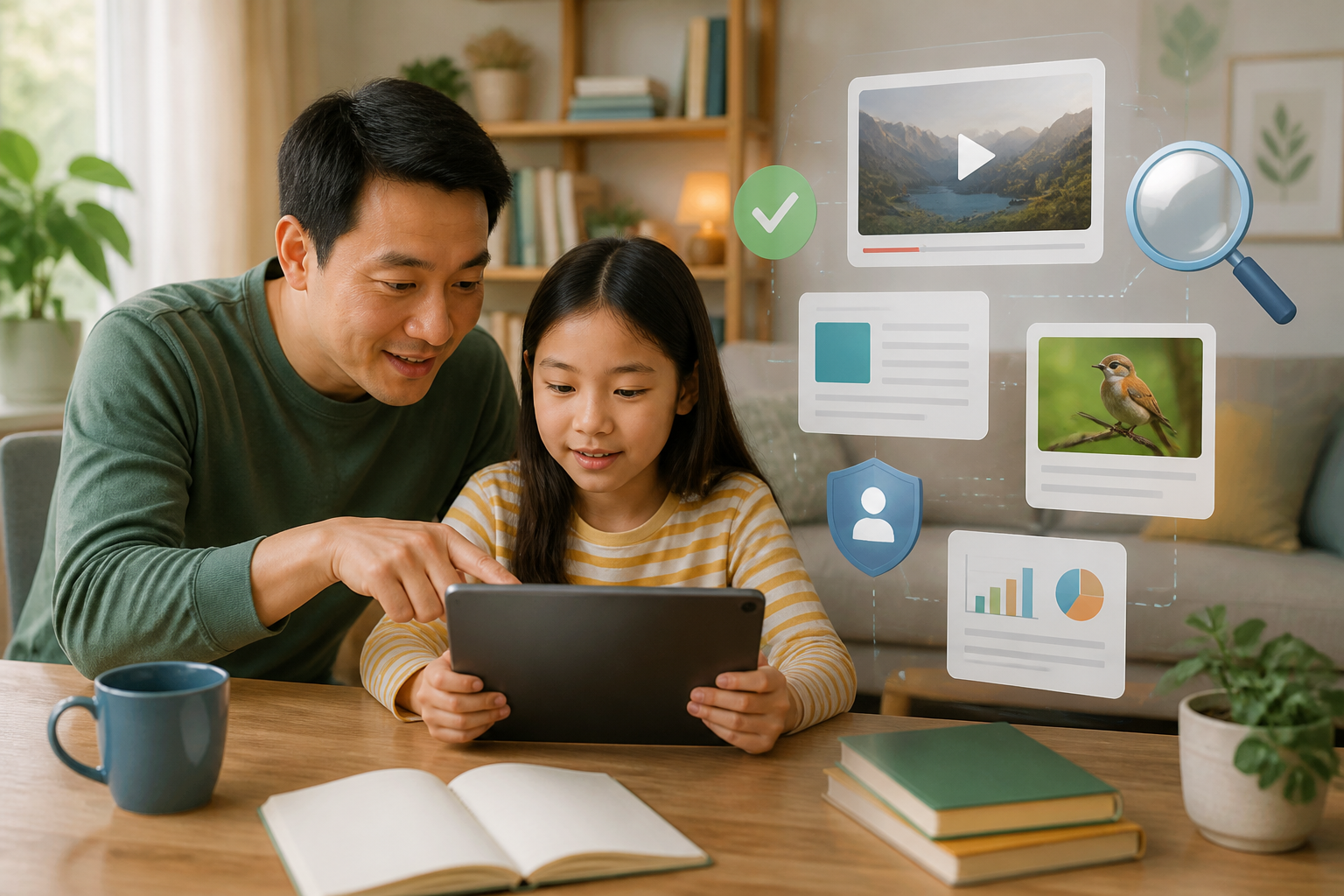
Kids can find funny videos, shocking news, or images that look very real with just a few scrolls. The problem is, convincing appearances do not always mean the information is true. Videos can be edited, given misleading titles, recreated with artificial intelligence, or taken from old events and spread as if they are new.
Therefore, teaching digital safety is not enough by just telling kids "don't trust the internet." Kids need practical ways to check information without feeling tested. This habit will be useful when they encounter viral videos, receive chain messages, or face AI-generated content.
Why do kids need to learn to check information?
Digital platforms do not only display the most accurate information. Recommendation systems typically select content deemed engaging, making people stop scrolling, watch longer, or react. As a result, shocking and emotionally charged content can appear repeatedly even if it is not necessarily accurate.
UNICEF explains that children need a combination of AI literacy, digital literacy, critical thinking, creativity, and online safety awareness to navigate the ever-changing digital environment. AI can also generate text, images, sounds, and videos that appear human-made. UNICEF states that the ability to distinguish trustworthy information is an important part of children's readiness in an AI world.
This does not mean kids must recognize all deepfakes or always know which news is fake. Even adults can be deceived. The goal is to build a reflex: stop, ask, check, then decide.
Five questions before believing or sharing content
1. Who created or uploaded it?
Teach kids to look at the account or source that first uploaded the content. Is their identity clear? Does the account often share information, or do they only appear to create sensational content?
The account name, number of followers, and amount of comments are not proof that the information is true. Popular accounts can also be wrong. Conversely, small accounts are not necessarily incorrect. This question helps kids understand that every piece of content has a creator with a specific purpose.
2. What evidence is provided?
Titles like “everyone should know” or “share before it’s deleted” should make kids more cautious, not immediately believe. Ask: is there data, location, date, documents, or statements from verifiable sources?
If a video only contains claims without explanations, kids can assess it as unproven information. Not everything needs an immediate answer. Saying “I don’t know yet” is a healthy thinking habit.
3. Is the context complete?
Short videos often omit parts before or after an event. A single sentence can sound harsh if cut from a long conversation. Old photos can also be captioned anew to appear related to current events.
Ask kids to check the upload date, location, and original caption. If possible, search for important keywords from the video using a search engine. Don’t just search for the same title; also look for names of places, people, or events mentioned.
4. Do other sources tell the same story?
One post should not be the sole basis for conclusions. Teach kids to compare information with two or three different sources, especially if the topic involves health, disasters, schools, safety, or someone accused of something.
Comparison does not mean looking for many accounts that repeat the same claim. Ten accounts can copy one incorrect source. What’s more useful is finding sources that provide different explanations, evidence, and context.
5. What do we want to do after seeing it?
This question is important because false information is often designed to prompt quick actions: to share immediately, click links, send money, or scold someone.
If the content makes kids very angry, scared, or overly excited, teach them to take a pause. Strong emotions do not always mean the content is wrong, but emotions can make us less careful.
Use the “3-Minute Pause” Method
For younger kids, the five questions can be summarized into a short exercise:
- Pause: don’t immediately forward or click.
- Check: see who uploaded it, the date, and the source.
- Compare: look for explanations from other sources.
- Think about the impact: could sharing this content harm or embarrass someone?
- Ask a trusted person: seek help if the content is confusing or concerning.
This exercise can be done using safe examples, such as science experiment videos, claims about animals, or sports news. Avoid using violent or sexual content as experiments with kids.
How to discuss AI-generated images and videos?
Explain that AI can create new images or videos based on patterns from many examples. The results can look real, but that does not mean the events actually occurred. Some signs like strange movements, unsynchronized sounds, awkward hands, or changing text can be clues, but they are not always easy to recognize.
Therefore, do not teach a single rule like “if the face looks weird, it’s fake.” It’s safer to say: the more shocking the claim, the more important it is to seek other sources. UNICEF also emphasizes that children need help understanding how AI can amplify misinformation and manipulate the information they see online.
If kids encounter fake images that embarrass or threaten someone, ask them not to save, download, or forward it. Immediately inform a trusted adult and use the platform's reporting mechanisms. For fake sexual content involving children, the FTC advises children to talk to parents or trusted adults and not share the content.
What parents and teachers can do now
- Make information checking a routine conversation, not just a reprimand when kids have already shared something.
- Ask “how do you think we can check this?” instead of directly saying “that must be fake.”
- Show examples when adults also need to check information before believing.
- Establish simple rules: do not share content that is not understood, especially if it concerns someone’s privacy or reputation.
- Ensure kids know they will not be scolded when reporting something confusing or scary.
The ultimate goal is not to make kids afraid of the internet. Kids still need space to play, learn, experiment, and create with technology. However, that freedom will be safer if accompanied by small habits to check before believing and think before sharing.
Sources & further reading
- UNICEF — Preparing children for an AI world
- UNICEF — How can generative AI better serve children’s rights?
- FTC — Talking with parents and kids about deepfakes, online safety, and the Take It Down Act
– Rio Yotto @rioyotto