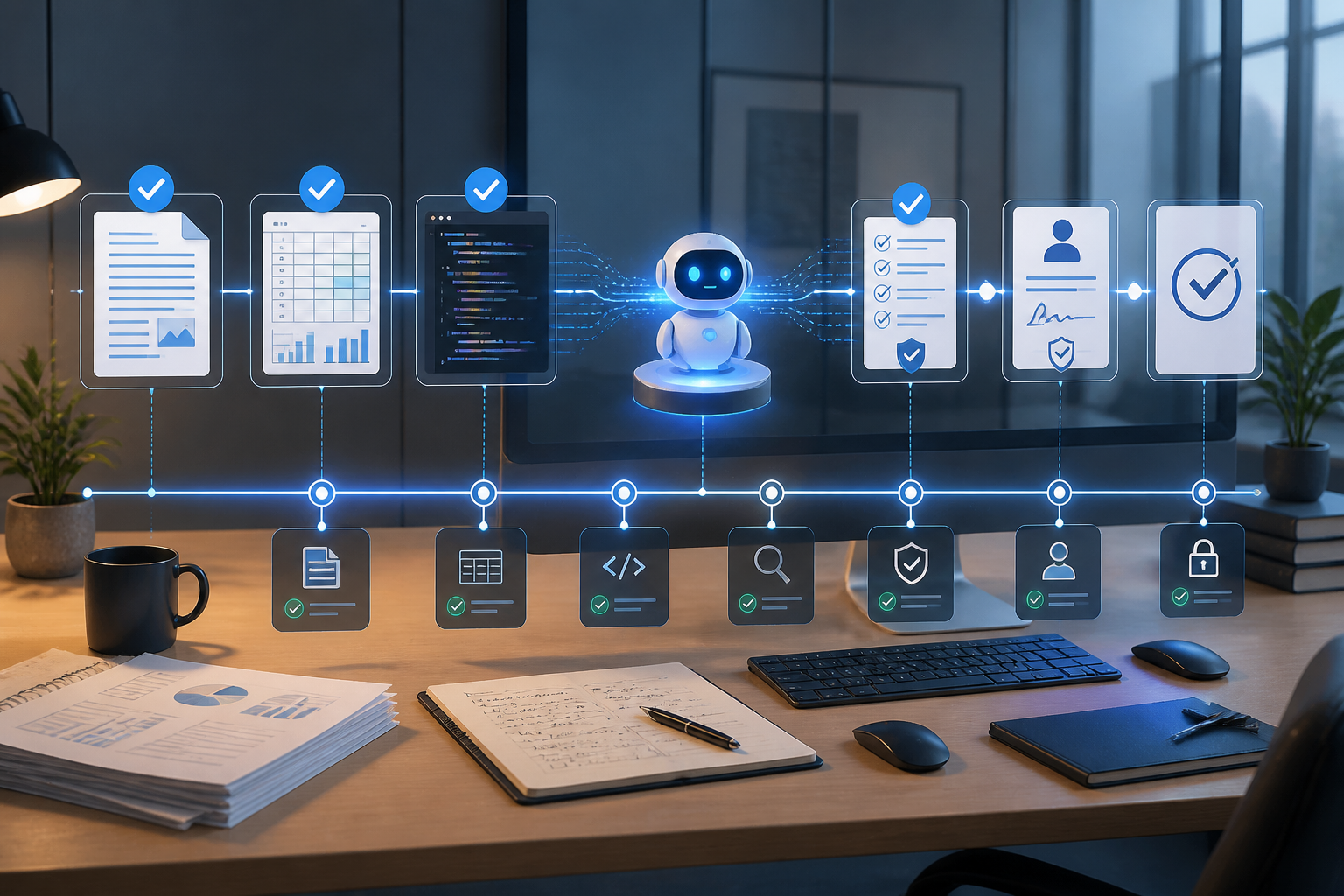
AI is beginning to shift from a tool for finding answers to a system that can perform work. It can read documents, write code, open spreadsheets, process data, create presentations, and compile final results without needing direction at every step.
This change is evident in how AI companies describe the use of their products throughout 2026. OpenAI reported that Codex users are increasingly assigning tasks with long durations, including work estimated to take more than eight hours for humans. Anthropic also showed that users with stronger domain knowledge tend to produce more successful AI work sessions.
This means the important question is no longer just “What can this AI do?”, but also “Can we understand, verify, and account for its processes?”
From answers to consequential work
Regular chatbots typically stop after providing a response. If the answer is incorrect, humans still have the opportunity to correct it before taking action.
AI agents operate differently. Once given a goal, they can break down the work into several steps, use tools, read sources, modify files, and produce output that can be used immediately. Small errors in the process can carry over to the final result.
For example, an agent might be asked to create a monthly sales report. It may pull data from a spreadsheet, calculate revenue changes, create graphs, and then write a summary for management. However, if one column containing return data is not included in the calculations, the report could look neat yet misleading.
This is where the final result alone is not enough. Users need to know what data was used, what assumptions were made, what steps were taken, and which parts still require human judgment.
Work traces are not just technical logs
In the software world, logs are usually seen as records for technicians. In AI agent systems, work traces serve a broader function. They become a way to answer several basic questions:
- What sources did the agent read?
- What tools or applications were used?
- What changes were made to files or data?
- Which parts were based on facts, and which were estimates?
- Who approved the final actions?
Anthropic, for instance, emphasizes the importance of controlled access, audit logs, and human approval in agent templates for financial work. In contexts like bookkeeping reconciliation, KYC document checks, or monthly report closures, agents can assist in preparing work, but the final decision must remain with the responsible person.
This kind of trace does not mean that every internal step of the model must be displayed in technical language. What is needed is a summary of the process that can be understood and verified. Users do not need to see the entire machine conversation, but they need to see relevant evidence to assess whether the results are usable.
Human expertise still determines quality
There is an assumption that the more autonomous AI becomes, the less humans need to understand the fields being worked on. Findings from Anthropic's research on Claude Code actually show a more complex pattern: people with better domain knowledge tend to provide more effective guidance, and their work sessions are more likely to end successfully.
This makes sense. An accountant can recognize unreasonable numbers even if the report looks professional. A programmer can see that the code runs successfully, but its design may be vulnerable under high load. An editor can know that a sentence is grammatically correct but contextually wrong.
In other words, AI may take over more execution decisions—such as choosing the order of steps or writing code—but humans still hold the directional decisions: what the work's goals are, the boundaries that must not be crossed, and what constitutes an acceptable result.
What this means for everyday users
For individual users, this change means we can assign larger tasks to AI. However, the way we give instructions also needs to change. Don’t just ask for “a report.” Include success criteria, allowable sources, data limitations, and the desired form of verification.
Better instructions might be: “Create a summary of expenses from this file. Separate recurring transactions from one-time transactions. Do not delete the original data. Mark numbers that lack categories, and include a list of assumptions before drawing conclusions.”
Such instructions make the work easier to verify. If the results are incorrect, it is also easier to identify at which stage the problem occurred.
What can be done now
- Start with cancellable tasks. Use AI to draft, group data, or prepare initial analyses before giving it access to send emails, modify databases, or perform transactions.
- Request intermediate outputs. In addition to final results, ask for lists of sources, assumptions, file changes, and unanswered questions.
- Separate read and write permissions. Agents should be able to read documents first without immediately having the rights to modify or delete them.
- Establish approval points. For actions that impact money, customers, reputation, or sensitive data, create rules that require human approval for the final step.
- Test with known answer examples. Before using it on real work, provide historical data and compare the agent's results with verified outcomes.
Not about slowing down AI
Requesting work traces and human approval does not mean rejecting automation. On the contrary, this process helps determine which parts are safe to run autonomously and which need oversight.
For simple and low-risk tasks, agents can operate quite freely. For work that affects financial decisions, personal data, or production systems, their level of autonomy should be lower and their records more comprehensive.
The development of AI in 2026 shows that the ability to perform long and cross-application work is becoming a primary focus. But that capability is only valuable if the results can be traced, tested, and accounted for. In the future, the most useful AI will not only be the one that can complete tasks but also the one that can demonstrate why its results are trustworthy.
Sources & further reading
- How agents are transforming work
- Agents for financial services
- Agentic coding and persistent returns to expertise
- Trustworthy agents in practice
– Rio Yotto @rioyotto