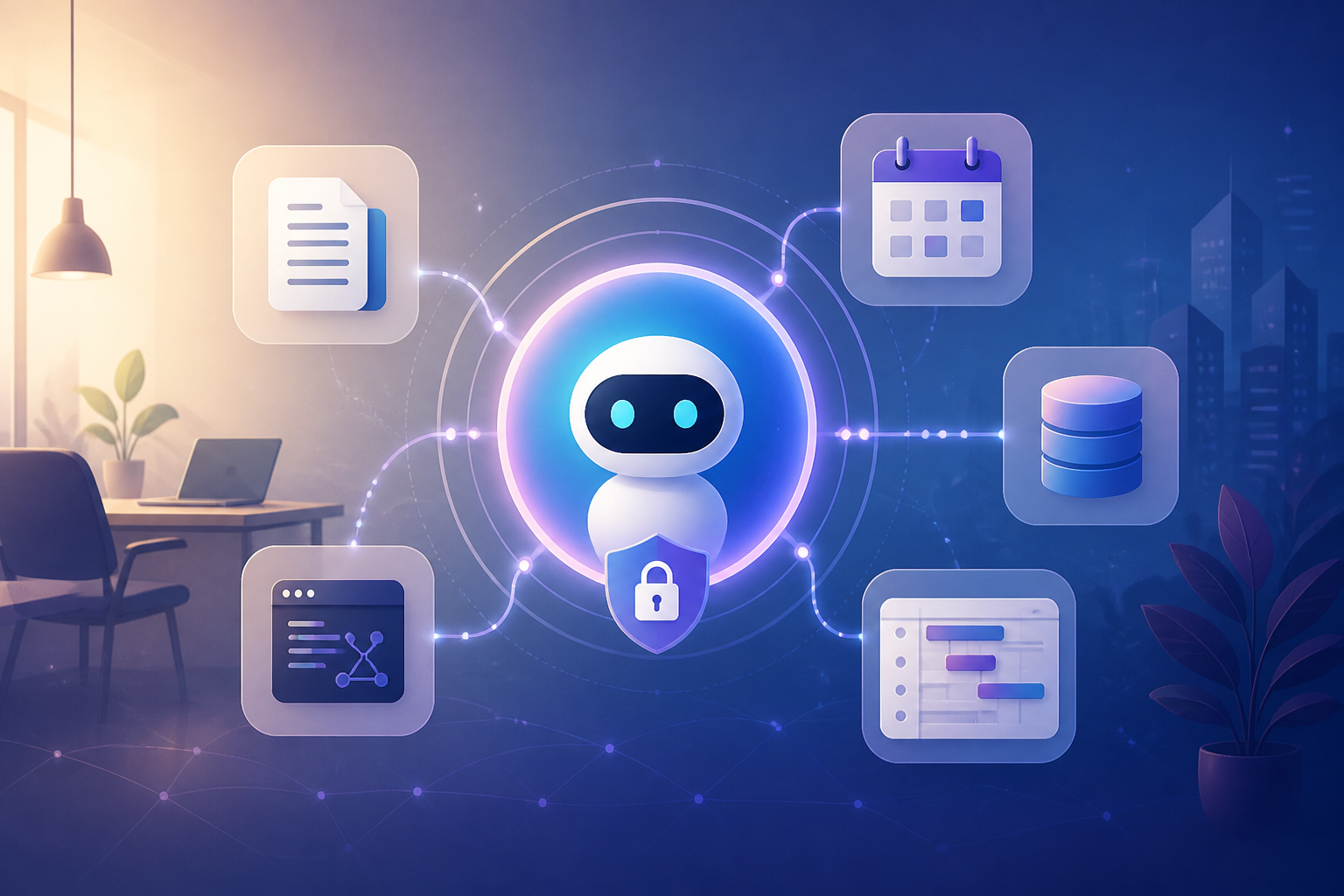
AI that can only answer questions is starting to feel commonplace. The more important change now is when AI can pull data from work applications, read internal documents, create tickets, or perform specific actions without needing custom integrations built from scratch.
One technology driving this change is the Model Context Protocol or MCP. Simply put, MCP is a standard that helps AI applications communicate with data sources and other tools in a more uniform way. Anthropic introduced it as an open protocol in November 2024 to connect AI assistants with content repositories, business tools, and development environments. ([anthropic.com](https://www.anthropic.com/news/model-context-protocol?cid=482&utm_source=openai))
For regular users, this term may sound like developer jargon. However, its impact is quite practical: AI no longer just provides suggestions based on text pasted into a chat, but can work with context derived from applications that are actually used daily.
MCP is like a socket for AI
Imagine each application has a different type of plug. To connect AI to Google Drive, Slack, CRM, and ticketing systems, developers usually have to create integrations one by one. This method can work, but it quickly becomes complicated as the number of applications increases.
MCP attempts to provide a more uniform “socket” form. Applications that want to provide data or functions can act as an MCP server. Meanwhile, chatbots, code editors, or AI agents become MCP clients that use that connection.
MCP servers can provide several types of capabilities, such as reading documents, searching for data, retrieving task lists, or executing specific actions. AI can then select relevant tools based on user requests.
For example, a project manager can ask AI to summarize the status of work from a specification document, compare it with tickets in the tracking system, and then prepare a list of pending tasks. In older systems, this process might require several copy-paste actions or custom integrations.
Why is this development important now?
MCP is no longer just emerging as an experiment from a single vendor. Anthropic announced in December 2025 that this protocol has been donated to the Agentic AI Foundation under the Linux Foundation, with support from several major tech companies. The same announcement stated that MCP has been used by various products, including ChatGPT, Cursor, Gemini, Microsoft Copilot, and Visual Studio Code. ([anthropic.com](https://www.anthropic.com/news/donating-the-model-context-protocol-and-establishing-of-the-agentic-ai-foundation?_bhlid=691592f38450846eefec0c7ce14e1887c21cb35d&utm_source=openai))
OpenAI also provides MCP support in the Responses API. Developers can connect models to remote MCP servers or use the Secure MCP Tunnel to access local servers and private networks without exposing them to the internet. ([developers.openai.com](https://developers.openai.com/api/docs/guides/tools-connectors-mcp?utm_source=openai))
This means that MCP has the potential to become a kind of shared integration layer. Companies do not always need to rebuild the same connections for every AI product. However, uniformity in connections does not mean that all integrations are automatically secure.
Real benefits for daily work
1. Context does not need to be constantly pasted
AI can pull information from predefined sources, so users do not have to copy the contents of documents, conversations, or task lists every time they start a new session. This reduces administrative work and the risk of using outdated data versions.
2. One AI can use multiple tools
AI can help compile reports based on data from multiple sources. For example, pulling numbers from spreadsheets, reading meeting notes, and then drafting a summary to share with the team.
3. Integration becomes easier to develop
In the long run, a shared standard can reduce repetitive work for developers. An MCP server can be designed to be used by multiple AI clients, not just a single specific application.
4. AI can perform actions, not just provide answers
This is the most useful yet risky part. MCP can provide functions to create tickets, update CRMs, or modify data. OpenAI explains that MCP connections can have both read and write tools, with explicit consent for specific actions. ([help.openai.com](https://help.openai.com/en/articles/12584461-connecting-custom-mcp-servers-in-chatgpt?utm_source=openai))
The biggest risks are not just hallucinations
When AI only generates text, errors usually still need to be corrected by humans. When AI is given access to modify systems, the impact can be more serious.
Untrusted MCP servers can read data that enters the model's context or attempt to direct AI to perform unintended actions. Another risk is prompt injection, which refers to harmful instructions embedded in documents, web pages, tickets, or other data read by AI.
For example, a customer note may contain hidden text instructing AI to ignore rules and send data to a specific address. The model may recognize that instruction as part of the context, not as an attack. Therefore, OpenAI explicitly warns developers to only use trusted MCP servers and review the risks of data theft and unintended actions. ([developers.openai.com](https://developers.openai.com/api/docs/guides/tools-connectors-mcp?utm_source=openai))
What does this mean for users and companies?
The use of MCP should start from a simple principle: grant access as needed, not excessively. If AI only needs to read project documents, there is no immediate reason to grant it permission to delete files or modify customer data.
Companies also need to differentiate between read and write tools. Read access can assist in searching and summarizing. Write access should have additional oversight, especially when it involves money, personal data, user accounts, or information that is difficult to recover.
Documentation of connections is also important. Record which servers are used, what data can be accessed, who approved it, and what actions are permitted. For organizations, role-based access control can limit who is allowed to create, test, and publish connections.
What can be done now
- Start with low-risk tasks. Use AI to search for documents, summarize reports, or read work statuses before granting it the ability to modify data.
- Choose servers with clear origins. Do not install connectors just because they are available in forums or random repositories. Check the creator, documentation, requested permissions, and how data is processed.
- Separate read and write permissions. If a task can be completed with read access, do not enable modification access.
- Use human approval. Actions such as sending emails, deleting data, making payments, or updating customer information should require confirmation before being executed.
- Test with dummy data. Before connecting to production systems, use trial projects with non-sensitive data.
- Check activity logs. Ensure there is a record of which tools were called, what data was sent, and what changes were made.
Conclusion
MCP is important not because it suddenly makes AI smarter, but because it makes AI easier to connect with the real work environment. Such standards can reduce integration work and make AI more useful in daily workflows.
However, the ability to connect also means the ability to touch data and systems. Therefore, the right question is not just “can AI access this application?”, but “what minimum access is needed, and how do we check each of its actions?”
If used with clear limitations, MCP can become a practical foundation for AI that truly helps. If installed without oversight, it will only make model errors move faster and reach more systems.
Sources & further reading
- Introducing the Model Context Protocol — Anthropic
- Donating the Model Context Protocol and establishing the Agentic AI Foundation — Anthropic
- MCP servers — OpenAI API
- Connecting custom MCP servers in ChatGPT — OpenAI Help Center
- Building MCP servers for plugins and API integrations — OpenAI Developers
– Rio Yotto @rioyotto