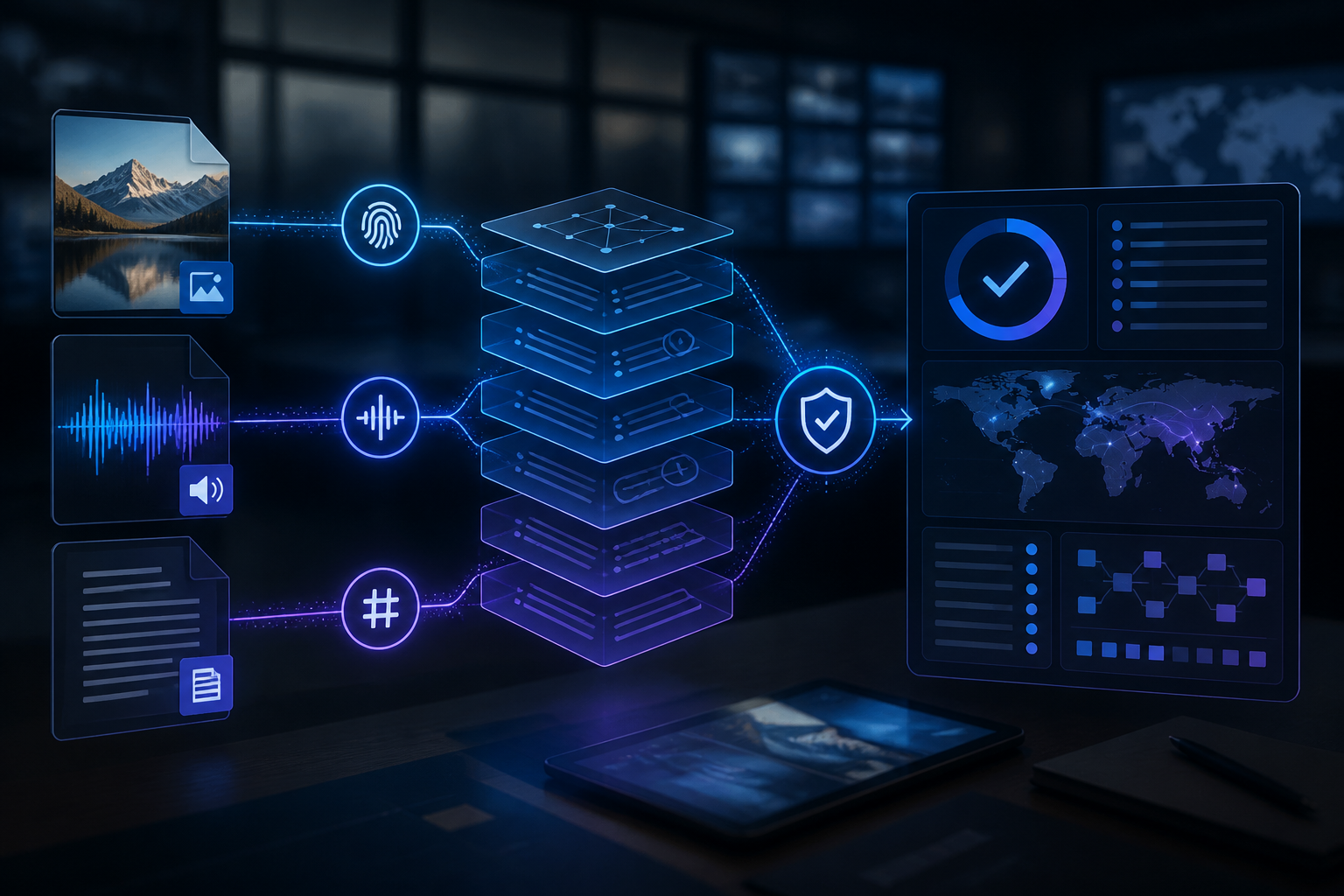
When a photo, audio recording, or video circulates in a family group, the important question is no longer just "is this real or fake?" We also need to know: who created it, has it ever been edited, and did any part of the process involve AI?
This need drives the development of content provenance, which is a digital trail that explains the origins and history of a piece of content. Its development is expected to be noticeable by 2026. OpenAI, for example, is expanding the use of Content Credentials, the SynthID watermark, and public verification tools for images and audio created with its devices. In the European Union, transparency obligations for AI-generated or manipulated content will also begin to take effect on August 2, 2026.
This does not mean the internet will have a magic button to ensure all content is accurate. However, at the very least, users will receive more context before trusting, sharing, or using a file.
What exactly are Content Credentials?
Content Credentials are information attached to a file that explains how that file was created or altered. Think of it like a history label on a document: a photo was taken with a camera, then cropped, color-adjusted, and exported by a specific application.
The widely discussed standard for this need is C2PA, which stands for Coalition for Content Provenance and Authenticity. This standard uses metadata and cryptographic signatures so that the provenance information of content can be verified and changes to its history can be tracked.
In practice, a file can store information such as:
- the tools or applications used to create the content;
- the actions taken, such as cropping, merging, or deleting specific parts;
- the time of creation or modification;
- the party that signed the information; and
- whether the creative process involved AI.
It is important to emphasize that Content Credentials do not assess whether the content is true, of high quality, or trustworthy. They only help answer questions about the origins and creation process. The C2PA specification itself emphasizes that this system validates provenance claims, not providing moral or truth judgments about a piece of content.
Why is a watermark not enough?
A digital watermark is a marker embedded within a file. In audio, for example, a watermark can be made inaudible to humans but still readable by verification tools. In images, a similar watermark can help detect that a file originates from a specific system.
The problem is that a single easy method has its drawbacks. Metadata can be lost when a file is re-uploaded, compressed, reformatted, or simply photographed from a screen. Conversely, a watermark may not retain sufficiently detailed history.
Therefore, a more sensible approach is to use multiple layers simultaneously:
- Metadata and digital signatures to store detailed provenance information.
- Digital watermarks to maintain signals when metadata is not carried along.
- Verification tools so that users, moderators, journalists, or developers can check those signals.
OpenAI explains that images created with some of its products can carry Content Credentials and the SynthID watermark, while supported audio can have a SynthID watermark. However, results that are "not detected" do not mean that the file was definitely created by a human. The signals may have been lost due to compression, screenshots, format conversion, or other editing processes.
This change is important for everyday work
For the general reader, provenance may sound like a concern for large platforms or media companies. In fact, its practical benefits are quite close to everyday activities.
A store owner can use AI-generated images for promotional materials but should still note that the images are not photos of the actual products. A communications team can verify whether an audio recording sent via email truly comes from the claimed source. Editors can see whether an illustration has only been color-corrected or has been substantially altered.
For organizations, provenance trails can also help establish verification procedures. For example, files used for broadcasts, reports, or public campaigns should undergo provenance checks before publication. OpenAI even provides an API to check provenance signals on images and audio in moderation, fact-checking, and security workflows.
However, such systems are most useful when used as additional evidence, not as the sole judge. In high-risk contexts—such as news, fraud, health, or legal decisions—the results of automated tools still need human review.
How do transparency rules drive this forward?
The European Union has made transparency a part of the AI Act. Its official guidelines state that AI system providers need to design systems so that AI-generated or manipulated content has machine-readable markers. For certain conditions, parties using AI also need to inform people when they interact with AI or view content like deepfakes.
This regulation does not automatically make all content on the internet easily verifiable. The challenges remain significant: standards must be implemented by many providers, platforms need to maintain metadata, and users must understand the meaning of verification results.
Nevertheless, the direction is clear. Content transparency is beginning to shift from simple labels like "created with AI" to systems that can store the history of creation and changes in a more structured manner.
What can be done now
- Do not assume AI labels as proof of truth. Labels only explain the creation process, not whether the information within is accurate.
- Keep original files. If you create or receive important content, save the first version before it is compressed or re-edited.
- Check sources and context. Valid metadata does not replace the need to verify who disseminated the content and for what purpose.
- Use verification tools as additional signals. Detected results mean certain signals were found; undetected results are not proof that the content is definitely not AI-generated.
- For businesses, establish internal rules. Define when AI content must be labeled, who checks it, and when human approval is required.
It’s not about hunting down all AI content
The debate about AI-generated content often gets caught up in the question of "how to catch it?" The provenance approach offers a slightly different question: "what information can we provide to help people better assess content?"
That is a more realistic approach. AI will continue to be used to create illustrations, sounds, videos, and text. What is needed is not a promise that all content can be perfectly proven, but an ecosystem that makes the origins, changes, and limits of certainty of a file easier to understand.
Ultimately, such a digital trail does not replace human judgment. It only helps us start the verification process from a better place.
Sources & further reading
- Advancing content provenance for a safer, more transparent AI ecosystem
- Content provenance — OpenAI API
- C2PA Technical Specification 2.4
- Guidelines on transparency obligations for providers and deployers of certain AI systems
– Rio Yotto @rioyotto