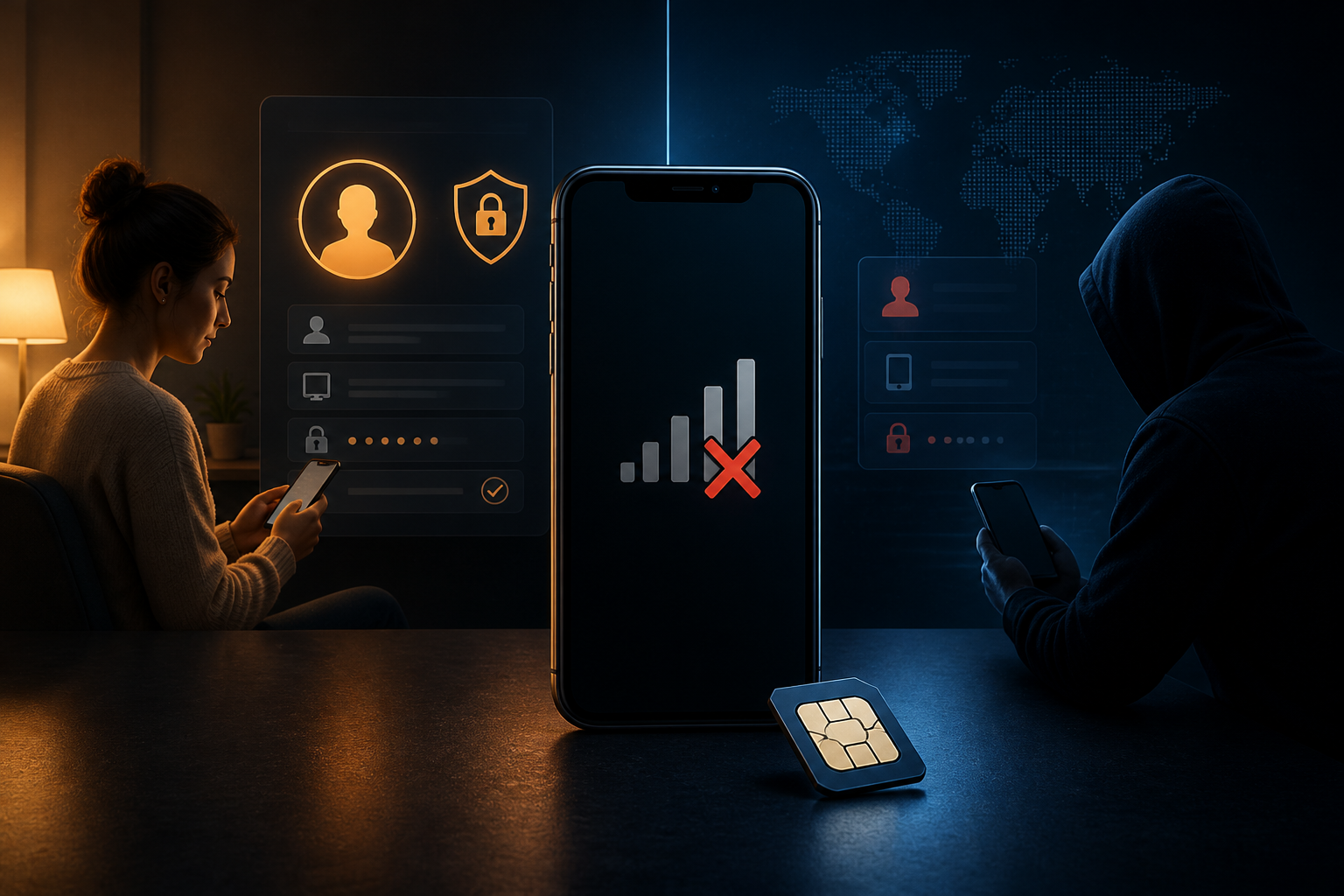
Imagine your phone suddenly can't receive SMS, make calls, or use mobile data, while those around you are not experiencing the same issue. Many people immediately blame the network. However, in certain situations, this condition can be a sign that the phone number is being transferred to another SIM card or device.
This attack is known as SIM swap. Scammers convince the mobile operator that they are the owner of the number who has lost or changed their phone. If the process is successful, the victim's SIM card is no longer connected to the network, while the scammer starts receiving calls, SMS, and verification codes sent to that number. There is also a similar attack called port-out fraud, where the number is transferred to another operator.
The problem is not just the loss of connection. Phone numbers are often used for email recovery, social media, digital wallets, banking, and other services. If the scammer also knows the email address or old password, they can attempt to take over accounts in a chain reaction.
Why SMS codes are not always enough?
OTP codes via SMS are indeed better than having no additional verification at all. However, SMS relies on control over the phone number. If that number has already been transferred to the scammer's SIM, the code that the victim should receive goes to the scammer's device instead.
That is why multi-factor authentication or MFA, which verifies login with more than one proof, should not rely solely on SMS for important accounts. The FTC recommends using an authenticator app or security key if users are concerned about SIM swap. CISA also includes securing mobile operator accounts as one of the important steps to reduce this risk.
Signs to watch for
- Your phone suddenly loses signal in places that usually have stable coverage.
- You receive a notification that the SIM card or number has been activated on a new device.
- You get an email alerting you to a password change, recovery number, or login device that you do not recognize.
- You cannot log into your account because the verification code is not being received.
- Your mobile operator sends a notification about a SIM replacement request or number transfer that you did not initiate.
One sign does not necessarily prove that a SIM swap has occurred. Network disruptions, a faulty SIM card, or device issues can also cause similar symptoms. However, a sudden loss of signal should be treated as a signal to check your accounts, especially if accompanied by suspicious notifications.
What you can do now
- Contact your operator through official channels. Use the customer service number on the official website, the operator's app, or billing documents. Do not use numbers sent via suspicious messages. Ask if there has been a SIM replacement, number transfer, or account data change.
- Add a PIN or password to your operator account. Many operators provide an additional layer of security to prevent unauthorized account changes. This PIN is different from your phone screen PIN and should not be easily guessed.
- Secure your email first. Your primary email often serves as the key to recover various accounts. Change the password from a trusted device, log out of unknown sessions, and check if the recovery address or phone number has changed.
- Change passwords for important accounts. Prioritize banking, digital wallets, social media, cloud storage, and work accounts. Do not use the same password for multiple services.
- Replace SMS with an authenticator app or security key. This option does not make accounts immune, but it reduces reliance on the phone number as a login factor.
- Check transactions and account activity. Review login history, active devices, profile changes, transactions, and notification emails. If there is any suspicious activity, report it immediately to the service provider.
Do not give scammers “fuel”
SIM swap often begins with information gathering. Full names, phone numbers, birth dates, addresses, or answers to security questions can be found from social media, data breaches, fake forms, or conversations with victims.
Therefore, limit personal information that is posted publicly. Avoid uploading photos of documents, your primary phone number, home address, or details that could be used to guess security questions. If you receive a call asking for a verification code, operator PIN, or account data, hang up and contact the company through channels you find yourself.
Verification codes are the keys to your accounts. Official personnel should not ask you to read out a login code that you just received.
If your number has already been taken over
Speed is crucial. Contact your mobile operator and request to regain control of your number. Once access is restored, change the passwords for your email and other important accounts. Check your bank accounts, payment cards, and digital wallets for any unknown transactions. If there are losses or account changes, report them to your bank, service provider, and relevant authorities.
Do not wait until all accounts are compromised. Prioritize your primary email as this account is often used to reset passwords for other services. After that, check recovery settings and remove any foreign numbers or devices from each account.
What does this mean for us?
Phone numbers are convenient, but they are not a perfect digital identity. Relying on SMS for all accounts is like keeping many keys on one keychain: easy to use, but the impact is significant if that keychain falls into the wrong hands.
The most sensible step is to create layers of security. Set a PIN on your operator account, use unique passwords, enable MFA that does not rely on SMS for important accounts, and make it a habit to check security notifications. This way, a loss of signal is not just seen as a technical disruption, but also serves as a reminder to check our digital entry points.
For consumer explanations about SIM swap, see the FTC guide on SIM swap scams. The FCC also explains the difference between SIM swap and port-out fraud, while CISA provides recommendations for securing mobile communications and operator accounts.
Sources & further reading
- FTC: SIM Swap Scams: How to Protect Yourself
- FCC: Protecting Consumers from SIM Swap and Port-Out Fraud
- CISA: Mobile Communications Best Practice
– Rio Yotto @rioyotto