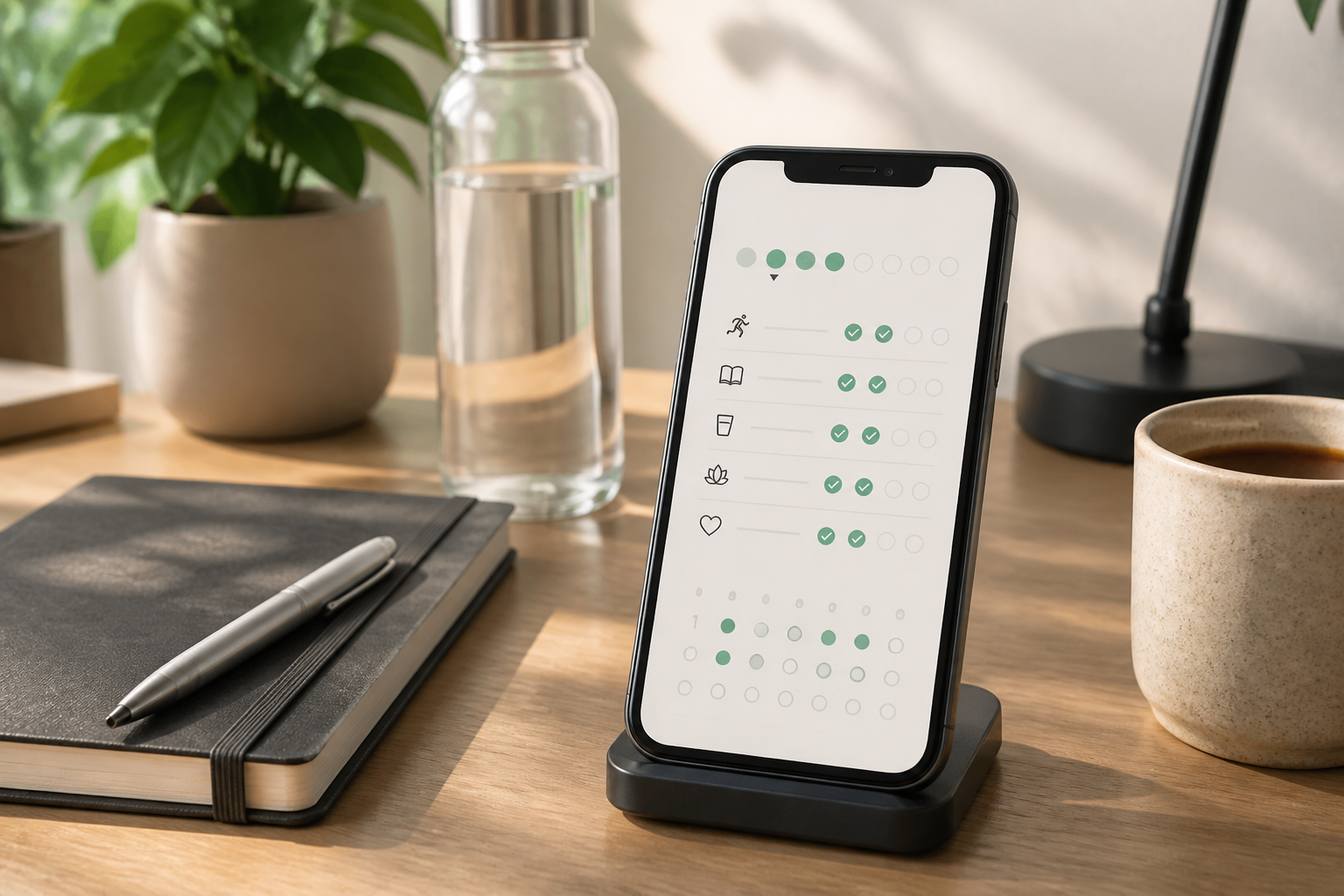
Habit tracker apps often seem simple: create habits, check off each time you complete them, and then see the streak of successful days. The problem is, many people stop not because the app is lacking, but because the habits they set are too big, too many, or lack a clear connection to their daily routines.
Habit trackers are most useful when used as a mirror, not as a judge. They help us see whether habits are actually being performed, when we often fail, and what conditions make them easier to maintain. However, decisions about habits still need to be made consciously.
Start with behaviors, not end results
A common mistake when creating a habit list is writing targets that are actually end results. For example, "becoming healthier," "being more productive," or "learning English fluently." All of these are important, but they are too broad to check off every day.
Transform those targets into observable behaviors. For example:
- Walking for 15 minutes after lunch.
- Reading five pages before bed.
- Completing one English exercise.
- Writing down three work priorities before opening email.
The difference may seem small, but the impact is significant. An app can only record something clear: done or not done. The more concrete the behavior, the less likely we are to debate with ourselves when the time comes.
Choose an app based on your thinking style
There is no one-size-fits-all habit tracker app. Some people need a visual calendar view. Others prefer a simple list. Some are motivated by statistics, reminders, or reward systems.
Before choosing an app, ask yourself three questions:
- Do I need reminders? If you often forget, notification features and recurring schedules are more important than a complicated design.
- Do I like seeing data? Weekly graphs can help identify patterns, but they may feel overwhelming for users who just want to check off tasks.
- Are my habits tied to specific times? For morning or evening habits, an app with time-based scheduling may be more helpful than one that only displays a daily list.
Also consider practical aspects such as ease of data export, device synchronization, subscription costs, and privacy policies. Habit records may seem non-sensitive, but sleep patterns, exercise, health, or specific consumption are still personal data that should be managed carefully.
Don't create ten habits at once
A long list of habits can feel motivating on the first day, but it quickly turns into a list of debts. Each missed check adds to the feeling of failure, and soon the app is no longer opened.
To start, choose one to three habits that will have the most impact. Use a simple question: If I could only succeed in doing one small thing over the next two weeks, what would be the most helpful for my life?
A small number does not mean low ambition. In fact, a short list allows room to test whether the habits fit into a real schedule. Once they are stable, you can add other habits if needed.
Create a minimum version of each habit
Habits often fail because we only prepare the ideal version. A plan to “exercise for one hour” sounds great when energy is high, but feels impossible after a tiring workday.
Create a minimum version that still matters. For example:
- Exercising for one hour becomes stretching for five minutes.
- Reading 30 pages becomes reading two pages.
- Cleaning the entire desk becomes returning five items to their place.
- Studying one chapter becomes opening the material and doing one question.
The minimum version is not an excuse to always do less. Its function is to maintain a connection with the habit on tough days. On better days, we can still continue for longer.
Link habits to existing triggers
Reminders from apps help, but triggers from daily routines are often stronger. Instead of relying solely on a notification at 7:00 AM, link new habits to activities that are already certain to be done.
For example, after brewing coffee, write down three work priorities. After brushing your teeth, read two pages of a book. After closing your laptop, tidy up your desk for five minutes.
In this pattern, old activities become cues to start new activities. If one trigger is often missed, move the habit to a more stable moment. A good system follows our lives, not forces life to follow the app.
Use data to find patterns, not to blame yourself
After two or three weeks, look at your records with curiosity. Don’t just ask, “Why did I fail?” Also ask:
- On which days is the habit most often performed?
- Is the habit easier to do in the morning or evening?
- What usually happens before the habit is missed?
- Is the target too big for certain conditions?
From here, we may find that the problem is not a lack of discipline. It could be that the schedule is unrealistic, the trigger is too vague, or the app sends too many notifications. Small changes in time, duration, or location are often more effective than increasing motivation.
Don’t let streaks become the main goal
A long streak of days can indeed be motivating, but streaks can also make one missed day feel like a total failure. In reality, habits don’t disappear just because one box is empty.
Use a simple recovery rule: if you miss once, get back on track the next opportunity. Avoid the pattern of “I’ve already failed today, so I might as well stop until next week.” In practice, the ability to return to routine is more important than maintaining a perfect record.
The measure of success for a habit tracker is not how perfect the calendar is, but how quickly we return after going off track.
What does this mean for us?
Habit trackers are not machines for building discipline. They are tools to make behaviors visible, reduce reliance on memory, and provide material for evaluation. If used without a clear purpose, apps only turn habits into a new administrative task.
What can be done now is to delete most of the list, leaving one important habit, and then write down its minimum version. Identify existing triggers, choose a reasonable time, and evaluate after two weeks. If the habit isn’t working, fix the system first before blaming yourself.
– Rio Yotto @rioyotto