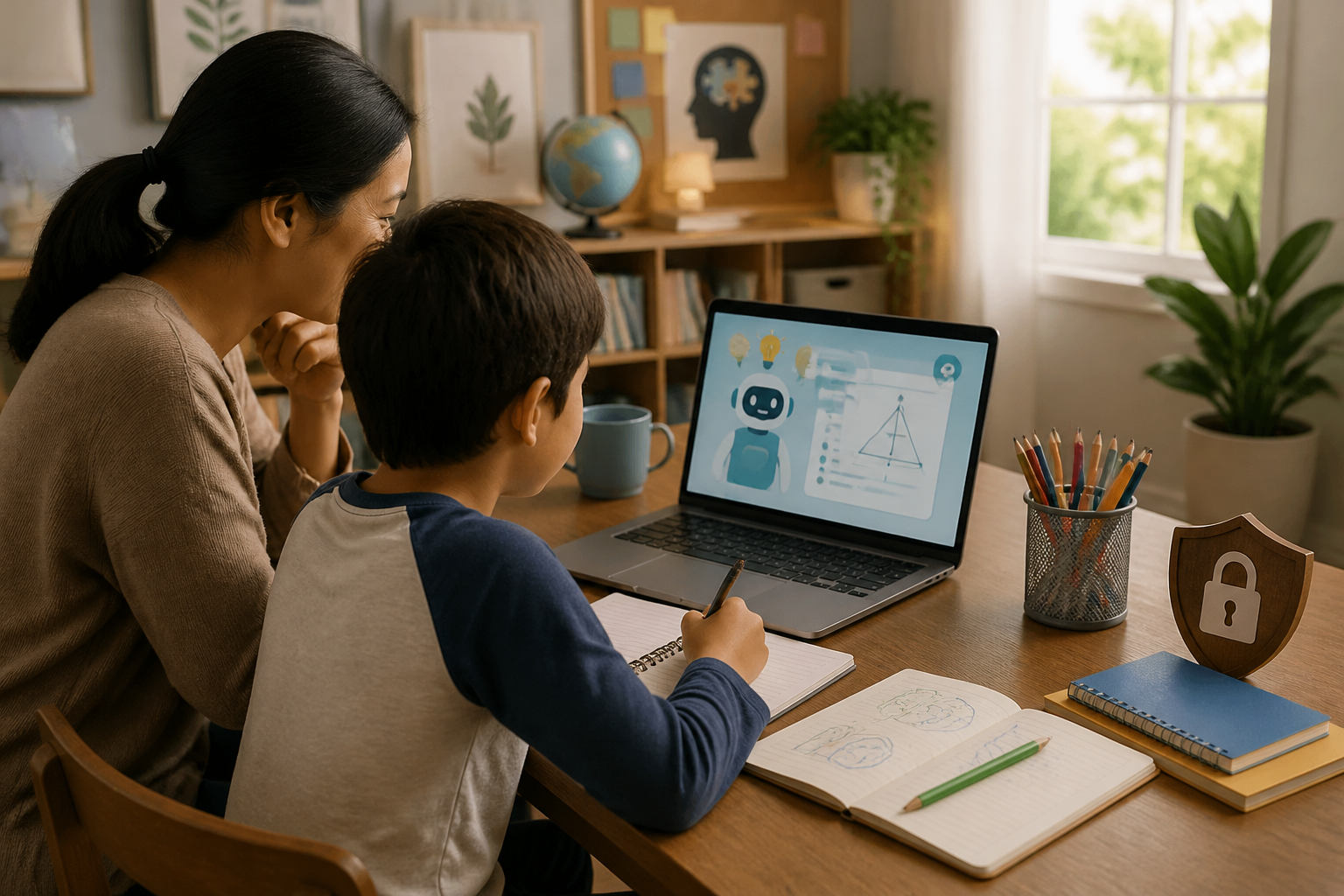
Children can now ask AI chatbots about math, language, science, and even how to create presentations. The issue is not just whether children should use AI, but how they use it. If AI is only used to copy answers, children may complete assignments without truly understanding the material.
On the other hand, banning all use of AI is also unrealistic. According to UNICEF, children need a combination of AI literacy skills, critical thinking, creativity, online safety, and an understanding of their rights in the digital space. Therefore, the goal of parents is not to keep children away from technology, but to help them build healthy habits while using it.
AI Should Be Positioned as a Tutor, Not a Proxy
A simple analogy is this: a calculator can help with calculations, but children still need to understand basic operations. The same goes for AI chatbots. They can provide examples, explain concepts in simpler language, or help children find mistakes. However, AI should not take over the entire thinking process.
This difference is evident in how children ask questions. Requests like “solve this problem and give me the final answer” encourage dependency. In contrast, questions like “explain the first step without giving the final answer” help children learn.
Analysis: the most beneficial use of AI for children is not the one that produces text the fastest, but the one that prompts children to ask follow-up questions, compare answers, and attempt to solve problems on their own.
Four Household Rules for AI Use
1. Try It Yourself Before Asking
Establish a rule that children need to read the problem, write down their guess, or attempt the first step before opening the chatbot. It doesn’t have to be perfect. The goal is for AI to be present after an effort has been made, not before children think.
For math assignments, for example, children can write down the formulas they think are relevant. For writing tasks, they can create a three-point outline first. After that, AI can be used to check or provide alternatives.
2. Ask for Guidance, Not Ready-Made Answers
Teach some safer question patterns:
- “Explain this concept with a simple example.”
- “Give me one hint, but don’t solve the problem completely.”
- “Check my steps and point out where I went wrong.”
- “Ask three questions so I can find the answer myself.”
These patterns turn AI into a tutor that aids the learning process. Children still need to explain things back in their own words.
3. Always Double-Check
AI can provide answers that sound convincing but are incorrect. UNESCO emphasizes the importance of a human-centered approach, data protection, and age-appropriate AI use in education. Therefore, children need to understand that chatbot answers are not an automatic source of truth.
Encourage children to check at least one of the following:
- Does the answer make sense?
- Are there numbers, names, or dates that need to be compared with textbooks?
- Is the source provided actually valid?
- Does the answer address the question or just sound smart?
For younger children, this checking can be done together with parents. For teenagers, ask them to show a comparison source or explain why they trust that answer.
4. Do Not Enter Personal Data
Children should not enter their full name, home address, phone number, ID photo, school location, private conversations, or health information into the chatbot. Even if the question seems trivial, data that has been shared can be beyond the family's control.
The practical rule is: if the information is not appropriate to write on a school bulletin board, do not enter it into the chatbot. Use fictional examples when context is needed, such as replacing a friend's name with “Rani” or omitting location details.
Protecting children's data is not just the family's responsibility. In the United States, COPPA regulations provide special protection for the personal information of children under 13 on certain online services. However, legal rules do not replace safe habits at home. Parents still need to read privacy policies and check if a service is indeed suitable for their child's age.
Create a Simple “Learning Flow”
Instead of just setting prohibitions, families can create an easy-to-remember flow for using AI:
- Understand the task. Children read the instructions and determine what is being asked.
- Try it yourself. Children write down ideas, formulas, or initial answers.
- Ask AI with limitations. Request explanations, hints, examples, or checks.
- Compare. Match AI answers with books, teachers, or trusted sources.
- Rewrite with their own understanding. Do not just copy the conversation results.
This flow also helps parents see if AI is truly being used for learning. Occasionally, ask children to explain the assignment without looking at a screen. If they can explain it in their own words, the likelihood of a stronger learning process is higher.
Adjust Rules According to the Child's Age
Elementary school-aged children usually need direct guidance. Parents can sit together, choose questions, and limit the services used. The main focus is to introduce that computers can help, but they are not always correct.
For teenagers, the rules can be more flexible but must come with responsibility. They can be given the freedom to use AI for generating initial ideas, language practice, or understanding concepts, provided they do not submit final assignments that are entirely machine-generated and still adhere to school rules.
UNICEF also places digital literacy, creativity, critical thinking, and online safety awareness as essential parts of children's readiness to face an AI-influenced world. This means that the skills to be developed are not just mastering one application, but understanding when technology helps and when it should be questioned.
What Can Be Done Now
- Choose one chatbot or learning tool to use, do not let children try services randomly.
- Create three written rules: try it yourself, do not enter personal data, and double-check answers.
- Use one school assignment as practice for asking for guidance, not final answers.
- Ask teachers about the school's policy regarding AI use.
- Review the rules every few months as the child's abilities and needs change.
A family technology use plan does not have to be complicated. The American Academy of Pediatrics recommends families create media rules that fit their routines, discuss them with children, and review them periodically. The same principle can be applied to AI.
Ultimately, the measure of success is not how quickly children complete tasks with the help of chatbots. The measure is whether children become more capable of asking questions, checking, explaining, and making decisions. If those four abilities grow, AI is in the right place: assisting the learning process without replacing the thinking process.
Sources & Further Reading
- UNICEF Innocenti — Preparing children for an AI world
- UNESCO — Guidance for generative AI in education and research
- American Academy of Pediatrics — How to Make a Family Media Plan
- Federal Trade Commission — Complying with COPPA: Frequently Asked Questions
– Rio Yotto @rioyotto