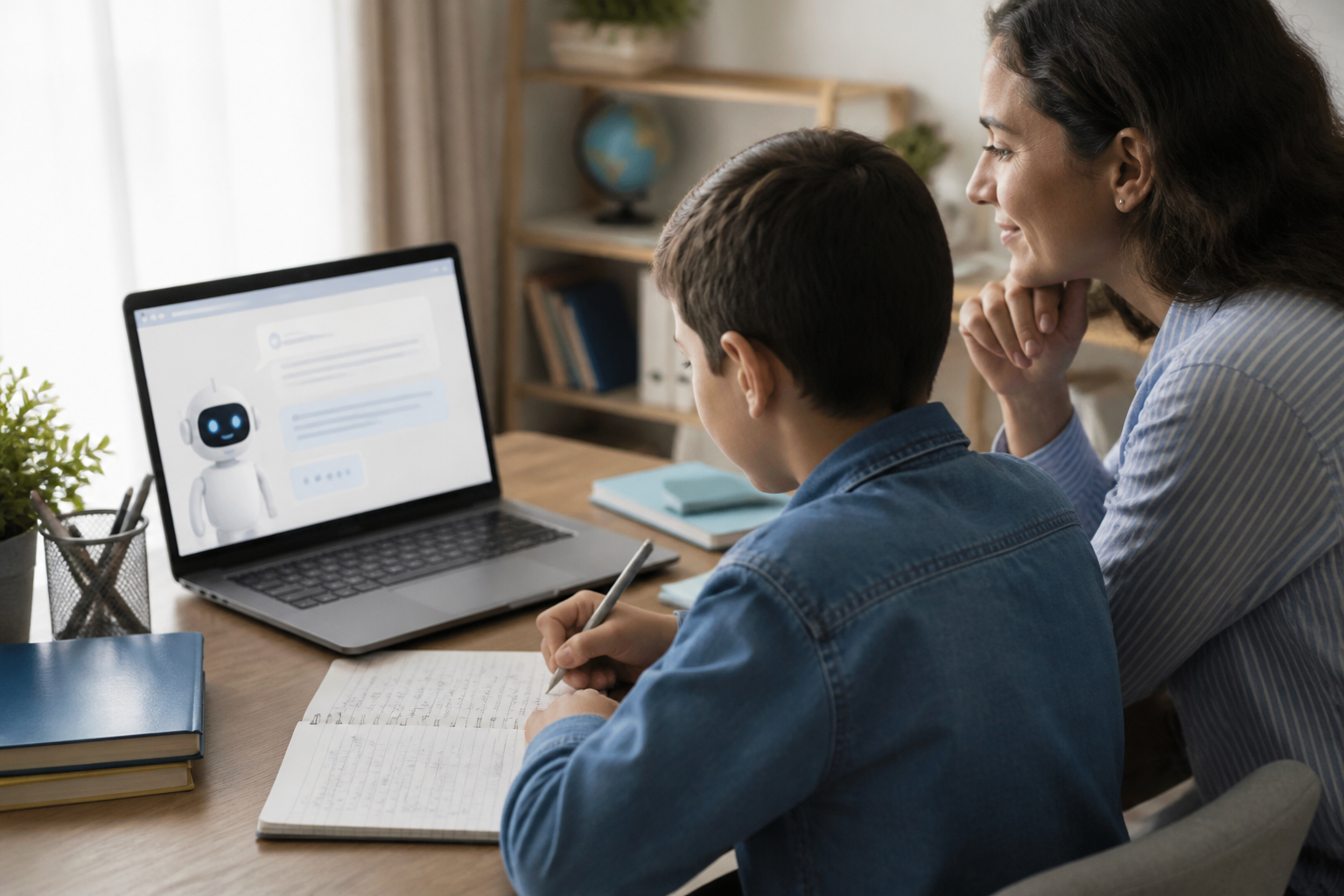
When children start using AI chatbots to seek explanations or complete assignments, the first reaction of parents is often to prohibit it. This concern is understandable: AI can provide answers that sound convincing even if they are incorrect, and children may become accustomed to handing over the thinking process to machines.
However, an outright ban is not a long-term solution. Children will likely still encounter AI at school, on the internet, or on friends' devices. More importantly, it is essential to build the habit of using AI consciously: as a learning aid, not a machine to replace effort.
UNICEF states that AI can help explain concepts, answer questions, and provide more personalized practice. On the other hand, too much assistance can eliminate productive struggle, which is the process of trying, failing, correcting, and ultimately understanding something through one's own effort.
The Issue is Not Just "Children Using AI"
Using AI for learning does not always mean cheating. There is a significant difference between asking for a simple explanation about fractions and asking AI to write an entire essay to be submitted.
The first example still allows room for children to think. They can ask follow-up questions, compare explanations, and then work on problems independently. The second example eliminates most of the learning process. The final result may look neat, but the child may not necessarily understand the content.
This is where parents need to change the questions they ask. Don't just ask, "Are you using AI or not?" Also ask, "Which part was assisted by AI?", "What did you verify?", and "Can you explain this answer without opening the app?"
Three Risks Children Need to Understand
1. Confident-Sounding Incorrect Answers
Generative AI can construct sentences fluently, but fluency in language is not a guarantee of accuracy. It can miscalculate, mix up dates, create non-existent sources, or oversimplify topics.
Children need to understand that AI's answers are a starting point for verification, not the final authority. For history assignments, for example, children can compare answers with textbooks, museum websites, or known educational sources. For math, they can redo calculations using their own steps.
2. Dependence on Instant Answers
Learning often feels slow and uncomfortable. Children need to try several times before finding the correct way. If every confusion is immediately resolved by AI, children may miss the opportunity to develop resilience, logic, and problem-solving skills.
A simple rule to try: try on your own first before asking AI. For younger children, five to ten minutes of independent effort is sufficient. After that, AI can be used to ask for guidance, not the final answer.
3. Personal Data Being Compromised
Children may not yet understand that conversations with applications can contain sensitive information. Full names, home addresses, photos of assignments that include school identities, phone numbers, or personal stories should not be shared carelessly.
UNICEF's guide on AI and children places data protection, safety, transparency, and the best interests of the child as essential parts of AI usage. At home, this principle can be translated into practical rules: do not input unnecessary data to answer questions.
Use a Pattern Before, During, and After
Parents do not need to monitor every word typed by their children. A brief routine is easier to implement than constant supervision.
Before Using AI
- Set learning goals. Does the child want to understand a concept, find examples, create exercises, or check their writing?
- Check school rules. Some assignments may indeed need to be completed without AI assistance.
- Ensure questions do not contain personal data or information about friends.
While Using AI
- Ask AI to explain steps or provide guidance, not to write the final answer directly.
- Teach children to ask for age-appropriate examples and use language that is easy to understand.
- Compare important information with other trusted sources.
After Using AI
- Ask the child to explain it back in their own words.
- Have the child highlight parts they still doubt.
- If AI helped with writing, ensure the final result still reflects the child's thinking and voice.
This pattern aligns with the approach recommended by Common Sense Media: AI should support the learning process, while children continue to perform essential tasks such as thinking, verifying, revising, and explaining.
Adjust Rules According to Age
Elementary school children are generally safer using AI with adults. The focus is not on exploring chatbots alone, but on seeing how questions are formulated and how answers are verified.
For middle school children, parents can provide more leeway with clear boundaries. For example, AI can be used to create practice questions or provide feedback on drafts, but not to complete entire assignments.
High school teenagers need to learn about transparency and academic responsibility. They can note when AI is used, which parts were assisted, and which sources were used for verification. This habit is more useful than simply hiding AI usage.
What Can Be Done Now
- Choose one simple task, then work on it together with the help of AI.
- Ask the child to find one mistake or weakness in the AI's answer.
- Compare the AI's answer with textbooks or educational websites.
- Create a family rule in one sentence: “AI can help with understanding, but it must not replace effort and honesty.”
- Review this rule every few months as the child's abilities and technology will change.
The ultimate goal is not to make children afraid of AI, but to make them critical enough not to trust it blindly. Children who can ask questions, verify, maintain privacy, and explain their learning outcomes will be better prepared to face any technology that emerges after today's chatbots.
Sources & Further Reading
- UNICEF — Parenting in the AI age
- UNICEF — Guidance on AI and children
- Common Sense Media — Using AI Wisely for School Success
– Rio Yotto @rioyotto