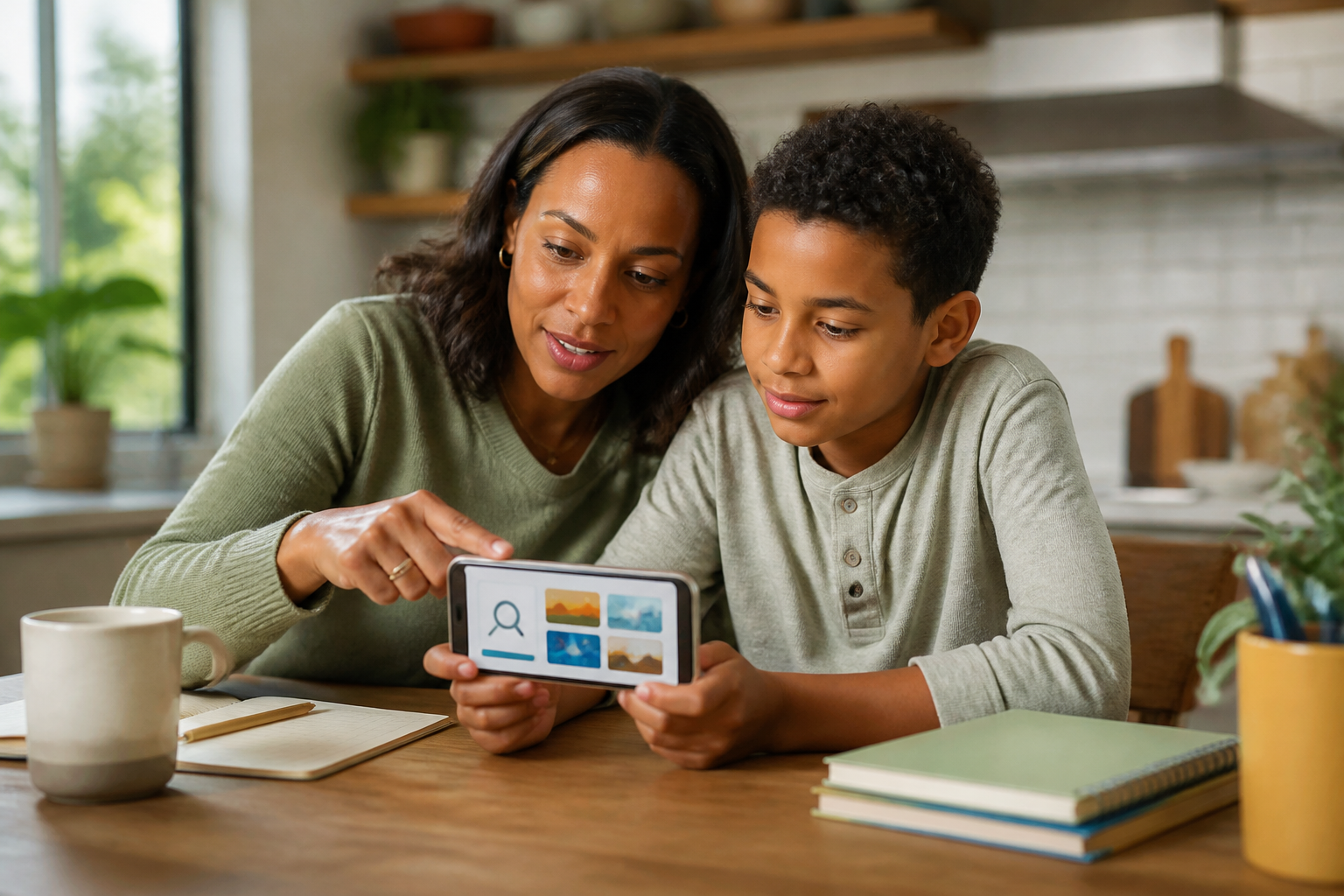
Short videos that seem convincing can appear on a child's screen at any time: news about rare animals, health claims, news snippets, or stories that an app can provide big rewards. The problem is, children often judge information by how it is presented—confident voices, dramatic images, or view counts—rather than the evidence behind it.
Therefore, an important skill to introduce is not just how to use applications, but media literacy. Simply put, media literacy is the ability to understand, evaluate, and use information critically and responsibly. UNESCO places this skill as an essential part of digital literacy, especially when children face misinformation, harmful content, and an ever-changing online environment. UNESCO's explanation of media and information literacy discusses this skill more broadly.
Children do not need to be taught to be suspicious of everything
The goal of digital education is not to make children think all information on the internet is a lie. Being overly trusting is indeed risky, but being overly cynical is not helpful either. Children need to learn to be healthily skeptical: open to new information but willing to check before drawing conclusions.
For example, when a child sees a video titled “This Plant Can Cure All Diseases,” adults do not need to immediately scold or say, “That must be a lie.” It is better to ask questions:
- Who created this video?
- What is the creator's purpose—providing information, selling something, or seeking a large audience?
- Where does the claim come from?
- Are there other sources that explain the same thing?
- Which parts are facts, and which are just opinions?
Such questions help children understand that a professional appearance does not automatically make information true.
Use a simple rule: pause, check, compare
Children usually find it easier to remember short patterns than long explanations. Parents or teachers can introduce the following three steps whenever a child encounters surprising information.
1. Pause before sharing
Content that makes someone very surprised, scared, angry, or overly happy often prompts quick reactions. Ask children to wait a moment before pressing the share button, commenting, or following a link.
A simple phrase to use is: “If the emotion is strong, let's check first.” This does not mean that all emotional content is necessarily wrong. However, strong emotions can make anyone less careful.
2. Check the creator and the context
Encourage children to look at the account name, upload date, video description, and mentioned sources. Old videos can be shared again as if they just happened. Edited clips can also remove important context.
Teach that a checkmark, follower count, or number of comments is not a single proof that the information is true. Large accounts can also be wrong, while small accounts might share accurate information. What needs to be checked is the evidence and the sources.
3. Compare with other sources
One video is one piece of information, not always a complete picture. Encourage children to look for a second or third source, especially from official agency sites, trusted media, or organizations that have expertise on the topic.
Common Sense Media also suggests that children check if the title matches the content, look at the publication date, and compare claims with other credible sources. Their guide on recognizing misinformation can be a family discussion material.
Differentiate facts, opinions, ads, and stories
Children often think all informative content is created for the same purpose. In fact, a post can be a fact, an opinion, a disguised advertisement, satire, or a fictional story packaged as news.
Use examples that are close to daily life. “This book has 200 pages” is a claim that can be checked. “This book is the most exciting” is an opinion. “Use this product and you will definitely be smarter” is a promotional claim that needs to be viewed carefully.
Small exercises can be done while watching videos together. Ask children to categorize several sentences into four categories: fact, opinion, advertisement, or unknown. The last category is important because children do not always have to immediately determine right or wrong.
Do not use mistakes as a means to shame
Children may have believed in fake videos or shared incorrect information. If adults respond with ridicule, children may learn to hide their online activities rather than become more careful.
A more useful response is to dissect the process together. Ask, “Which part made you believe?” then “What can we check next time?” In this way, mistakes turn into thinking exercises.
Adults also need to set an example. When receiving chain messages, do not immediately forward them while asking children to be more careful. Show the thought process out loud: “The title is shocking. I don't know the source, so I will check the date and look for comparison reports.” Children learn not only from rules but also from the habits they observe.
10-minute exercises that can be done at home
- Choose one video or post that is not too sensitive.
- Ask the child to explain the content in their own words.
- Mark parts that are facts, opinions, or calls to buy.
- Check who created it and when the content was made.
- Find one comparison source.
- Decide together: trustworthy, needs to be delayed, or not worth sharing.
For younger children, use examples from toy ads, experiment videos, or posts about animals. For teenagers, discuss provocative titles, anonymous accounts, edited content, and how algorithms can continue to show topics that make them stop scrolling.
What does this mean for us?
Digital literacy is not a one-time lesson. Platforms change, content formats change, and new technologies like AI make images, sounds, and videos easier to manipulate. UNESCO in the family guide for the digital age emphasizes the importance of family support so that children can benefit from the internet while facing risks such as misinformation, bullying, and harmful content.
The most realistic approach is not to monitor every second of a child's screen time, but to build a reflex: pause, check, compare. If this habit is formed, children will not only be safer when watching videos today. They will also be equipped to evaluate news, advertisements, chain messages, and new technology results they will encounter in the future.
Sources & further reading
- UNESCO: Media and Information Literacy
- UNESCO: Growing Up in a Connected World — A Family Guide for the Digital Age
- Common Sense Media: How to Help Kids Spot Misinformation and Disinformation
- Common Sense Media: News Literacy 101
– Rio Yotto @rioyotto